+86-13516938893

Menu
global purchase
Rose Water

recommended

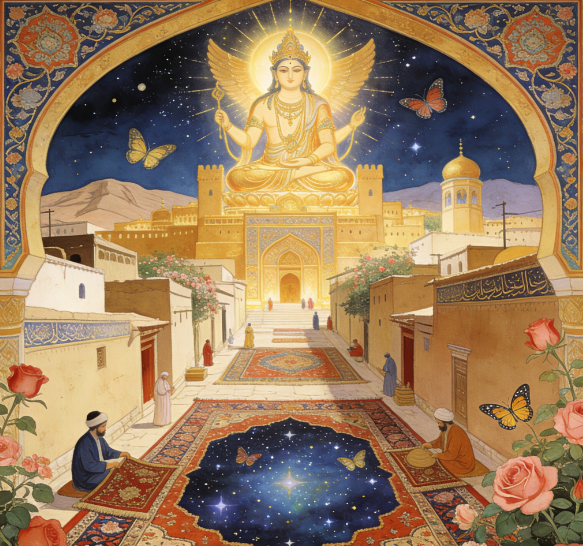
In the golden age of the Persian Empire, the city of Shiraz was renowned across the land for its roses—every alley wafted with their sweet fragrance, and the carpet workshop of the weaver Kaveh was nothing short of legendary. His carpets could reflect the rotation of stars, and the embroidered flowers seemed to lure butterflies to dance. In those days, the radiance of Ahura Mazda shrouded the earth, and people chanted the prayers of the Avesta. The roses of Shiraz were not merely symbols of beauty, but vessels of the sacred power of "condensed goodness."
Ahriman, the evil god, loathed the world’s beauty and sent his minions to spread the "Mist of Forgetfulness." As the black fog swept over Shiraz, the roses withered one by one, their petals fading to ashen dust. People’s goodness gradually faded—neighbors turned against each other, workshops shuttered, and Kaveh’s carpets could no longer weave stars, only dull, gray patterns remained.
Grieving for the withered roses in his garden, Kaveh’s heart ached like a knife. The oldest priest in the city told him: "The roses of Shiraz originate from the Heavenly Spring of Goodness, now sealed by the devil’s chains deep in the Kuhrud Mountains. Only a carpet woven with the Threads of Destiny can carry the power of goodness, break the chains, and revitalize the spring. And the Threads of Destiny lie hidden in the haoma grass guarded by the Simurgh."
Kaveh packed his belongings, took his weaving shuttle and an unfinished carpet, and embarked on his journey. He crossed the arid Dasht-e Kavir salt desert, where the scorching sun blazed down. Parched with thirst, the haoma seeds in his bosom suddenly took root and sprouted, oozing sweet nectar—a sacred plant in Zoroastrianism that awakens goodness and bestows strength.

Upon reaching the foot of the Kuhrud Mountains, a turbulent river blocked his path. Just then, a Simurgh with plumage as brilliant as a rainbow circled down. The divine bird of Persian mythology guarded truth and goodness. "Your goodness has guided you here," the Simurgh said as it carried Kaveh across the river. "The Threads of Destiny are not external treasures, but the perseverance and compassion in your heart. The haoma grass will help you awaken them, but you must resist the devil’s temptations."
Deep in the mountains, the devil’s illusions emerged: piles of gold and silver, power and status, even a revived rose garden—all trying to make Kaveh abandon his quest. But he remembered the expectations of Shiraz’s people. Grasping his weaving shuttle, he wove his goodness, love for his hometown, and the feathers gifted by the Simurgh into the carpet. A miracle happened: the carpet’s patterns rekindled with radiance, stars twinkled, and the withered rose motifs bloomed again. Golden threads stretched forth from the carpet—they were the Threads of Destiny.
Kaveh arrived at the Spring of Goodness, where the devil’s chains coiled around the spring, and black fog gushed from the gaps. He spread the carpet wide, chanted Ahura Mazda’s prayers aloud, and the Threads of Destiny transformed into a sharp sword, slicing through the devil’s chains. At the moment the chains snapped, the black fog dispersed, the Spring of Goodness flowed again, and clear water meandered down the mountains toward Shiraz.
When Kaveh returned to the city with the carpet, wherever the spring water flowed, withered roses sprouted anew, their petals regaining vivid hues, more fragrant than ever. People’s goodness was awakened—neighbors reconciled, and workshops reignited their fires. Kaveh laid the Carpet of Destiny in the city’s central square, where its stars and roses remained forever vibrant, becoming a symbol of Shiraz.
From then on, the roses of Shiraz became the most precious treasure of the Persian Plateau. People believed every rose embodied goodness. Kaveh’s weaving craft was passed down through generations, and weavers chanted prayers of goodness as they wove, infusing their carpets with blessings.
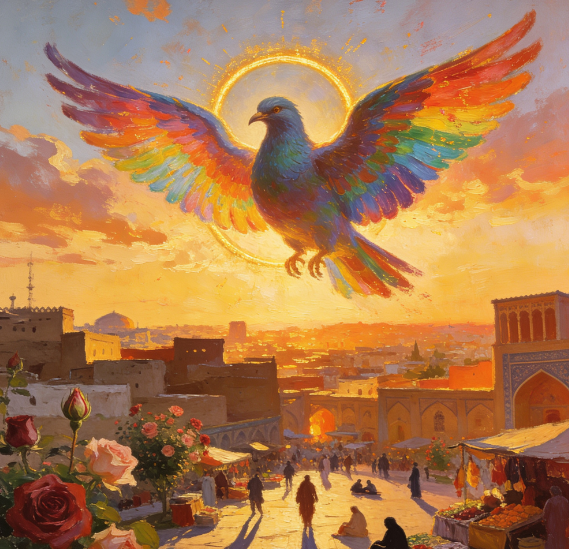
Occasionally, the Simurgh would appear in Shiraz’s sky, witnessing the city’s prosperity. People told Kaveh’s story for centuries, remembering: Goodness is not fragile. As long as one clings to justice and compassion in their heart, even in darkness, they can be reborn like the roses of Shiraz, blooming with eternal radiance.